
Curiosity lost
The Missing Intellectual Curiosity in Millenial and Gen Z Sales Professionals


The other day I was catching up with “Dave” (not his real name), an executive business leader in one of the largest technology firms in the world. We’d been talking for about an hour, covering a wide range of topics, when his frustration bubbled to the surface.
“Why do my teams not get this? You just understand!”
I was flattered. But instead of just nodding wisely, I offered him a perspective.
“For a variety of reasons, but I feel many of them are lacking intellectual curiosity to understand more widely what’s causing the customer problem and the wider industry dynamics they are facing.”
“RIGHT!!!” He exclaimed back at me
“Intellectual curiosity is the desire to acquire knowledge and understanding for its own sake — the drive to ask questions, seek explanations, and explore beyond what is required to solve an immediate problem. It is less about novelty or sensation, and more about the pursuit of insight, depth, and meaning.”
That struck a chord.
And it’s not just Dave’s teams — it’s a pattern I see repeated across many enterprise sales organizations, particularly among Millennial and Gen Z sales professionals who now dominate the field.
(BTW: “Dave” is Gen X and I’m at the extreme tail of inhabiting the ‘Boomer’ label.
Some have the same challenges most professional adults have faced in industrialized societies. They are building and supporting families, making money (lots of it!), navigating the minefield of company politics and distractions. They are adapting and evolving their professional rhythm to try to achieve that wickedly elusive life-work balance.
Now…Before I hear a a chorus of “Hey Boomer” ring out, I am father to an amazing Millennial sales leader who has been raised to be widely read and interested in all manner of subjects. She has culturally diverse knowledge and rather shockingly isn’t afraid to hold alternate views to me or her mother, nor is she afraid to express them. So I know this isn’t just generational dissonance.
So what has created this behavioral shift?
From Tests to Quotas: A Generational Conditioning
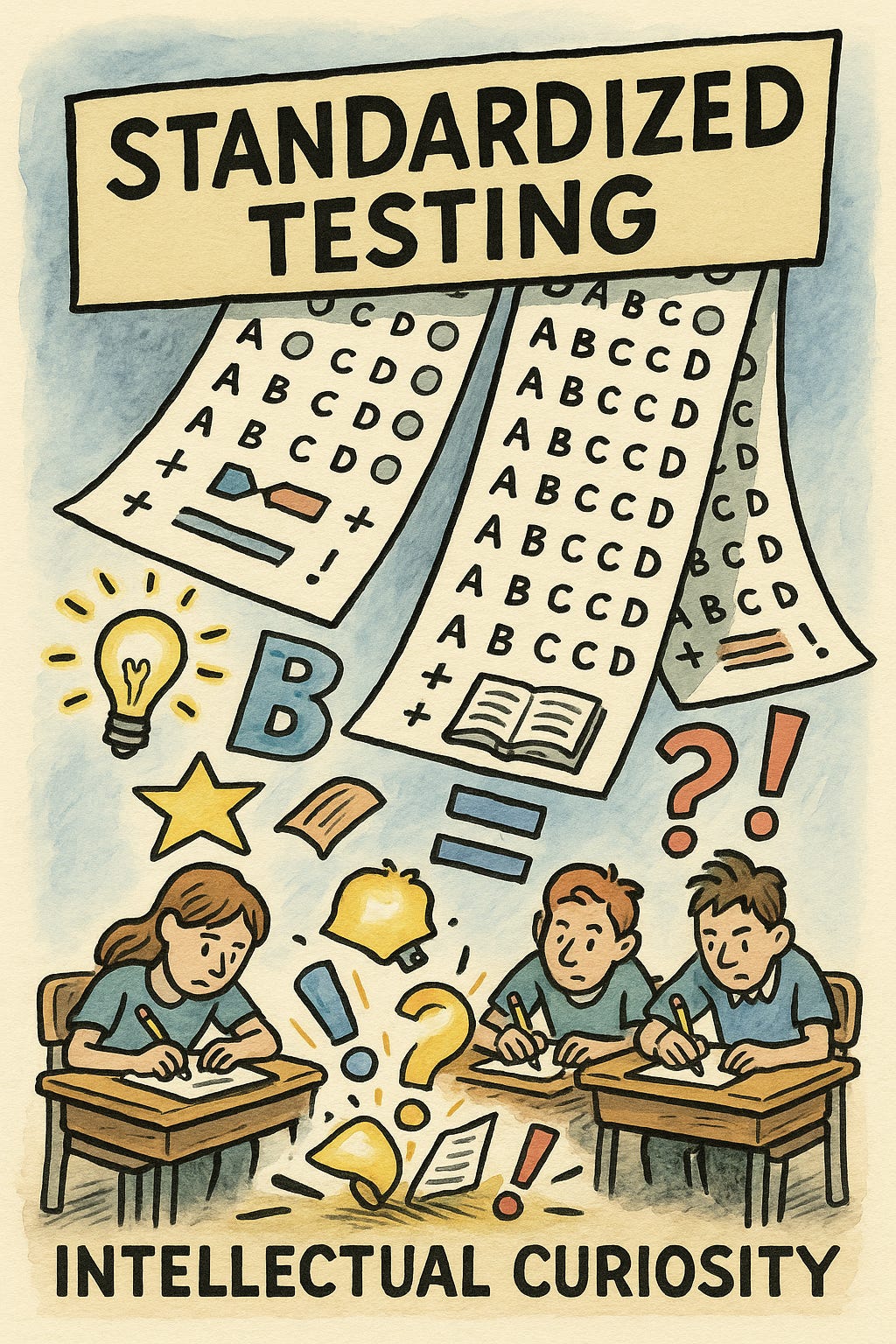
Long before Millennials picked up their first sales quota, they were shaped by another system: standardized testing. The late 1980s through the 2000s saw the rise of “teach to the test” culture in K-12 and higher education. Success wasn’t measured by depth of knowledge or genuine engagement with ideas; it was measured by test scores, rubrics, and compliance with pre-set standards.
Don’t believe me? Go read the work of Ken Robinson conducted on creativity, a close step brother of Intellectual curiosity. He describes how the formal education structures in western countries have been designed for control to the benefit of the teacher and order of the system, and as a side effect have crushed all measurements of creativity.
To make it more accesible for my multi media driven readers, here is his YouTube TedTalk (it’s been watched 78 million times)
Ken Robinson’s Ted Talk “Do Schools kill creativity”
Although this TED Talk is from 2006 and his original report from 1999, the topic is still active today. A recent Financial Time article cited the results of this in the contemporary workforce with executives across industries bemoaning the impact on their work forces.
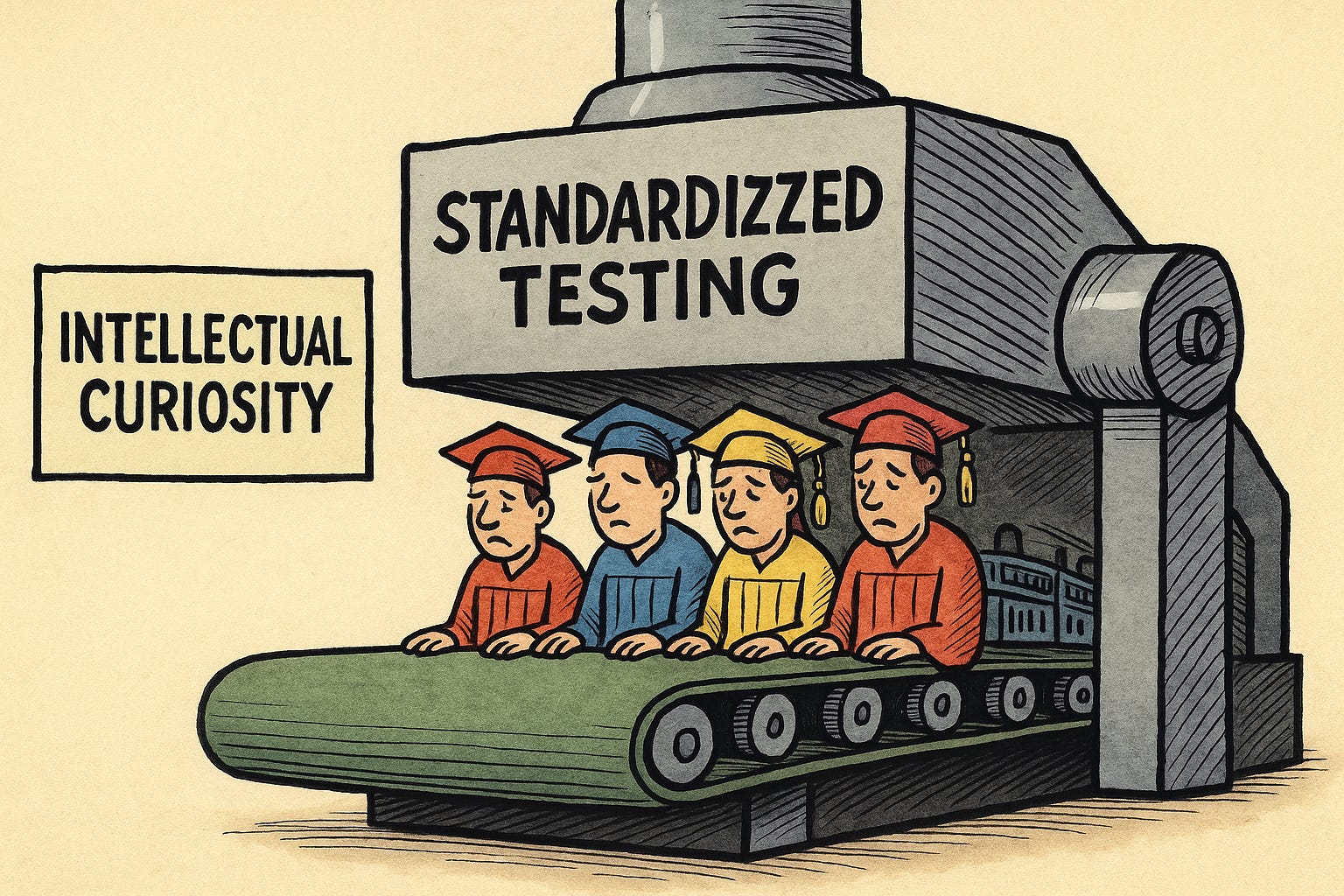
Although the FT article is paywalled, a summary of the Financial Times article reveals several compelling observations:
Employers across industries report concern that graduates are “excellent at taking instruction”—but lack independent thinking and creativity.
Spence argues that criterion-based assessments condition students to perform for the exam, not for deeper understanding or adaptability. He says:
“Criterion‑based assessment … assume[s] that the assessors know that one right answer. That is rarely true of real life.”This rewards conformity and discourages imagination, inquiry, and the ability to evaluate multiple options. Instead, students focus on delivering the “right answer,” not asking the right questions.
Declining enrollment in arts subjects (in favor of STEM) further reduces educational diversity. The arts, by contrast, nurture ambiguity, creativity, and originality—qualities increasingly demanded by employers.
International examples: In Singapore, the “Teach Less, Learn More” reform introduces broader curricula and collaborative learning to foster curiosity. Singapore now ranks highly in creativity assessments—models the UK and US opted out of.
Such skills—curiosity, adaptability, collaboration—are becoming essential in an unpredictable economy, and they’re often more prevalent among arts graduates rather than STEM counterparts.
Millennials: The Playbook Generation
The lesson for our Millennials and Gen Z was clear: study the material you need to pass, then move on. Don’t wander outside the syllabus. Don’t waste time on intellectual curiosity. The entire educational system conditioned a generation to optimize for performance metrics rather than expansive exploration.
By the time Millennials entered the workplace, they were already fluent in the language of compliance and efficiency. When they found themselves in enterprise sales, they stepped into a world that looked strangely familiar: activity dashboards, quota attainment charts, and playbooks that mirrored the multiple-choice tests of their youth.
Millennials didn’t invent the sales playbook, but they perfected it. CRM systems, sales enablement platforms, and scripted talk tracks were already entrenched by the time they arrived. Instead of being asked to “study your client’s industry” or “read widely about business strategy,” they were handed cadences and told to stick to the script.
It felt natural. Just as they once studied what was required to ace the exam, now they mastered the activity metrics that led to quota attainment. Why invest hours learning about logistics economics or healthcare policy if the comp plan only rewarded meetings booked and deals closed?
The result: an entire generation of sellers trained to optimize for compliance and execution, not for intellectual curiosity.
From Millennial Managers to Gen Z Sellers
Now Millennials are in management. They define the dashboards, set the coaching tone, and create the environments that Gen Z sellers must navigate. In effect, they’ve become the “teachers and coaches” this time around — and many are unconsciously recreating the same dynamic they grew up under: follow the system, hit the number, pass the test.
But the world outside has changed. Buyers are more educated, less trusting. AI is automating the rote parts of the sales process. Competitive landscapes shift faster than product sheets can keep up. What’s needed isn’t compliance — it’s intellectual curiosity. The willingness to dig deeper, to ask better questions, to learn beyond the script.
If Millennial managers don’t break the cycle, Gen Z will inherit a culture where intellectual curiosity is distraction, not a differentiator.
Intellectual Curiosity as the New Sales Edge
Ironically, the very trait that was sidelined in classrooms and sales floors alike is the one that now matters most. In an AI-driven world, efficiency is table stakes. What separates an excellent seller from an average one is the ability to connect dots across disciplines, industries, and ideas.
Don’t just learn an AI tool to be more productive. Learn to understand how it’s built, how does it works, what are it’s components, why it IS NOT Artificial General Intelligence…YET! And what the heck does that even mean? And what is the Turing test?…would I even pass it?)
Intellectual curiosity is the antidote to commoditization. It’s what enables a seller to say:
“I noticed your supply chain restructuring aligns with the new EU regulations — let’s talk about how that impacts your capital planning, what challenges do you see with that?”
That kind of open ended discovery and insight doesn’t come from a script or a dashboard. It comes from a habit of learning broadly and thinking critically — the very skills that standardized testing culture systematically downplayed.
Millennials have the opportunity to rediscover it. To encourage their teams to read beyond the slides, to reward exploration as much as execution, and to model intellectual curiosity themselves. In doing so, they can break the cycle and equip Gen Z with the most human advantage left in sales.
Key Takeaway

Millennials were shaped first by a school system that valued test scores over learning, then by sales systems that valued activity over intellectual curiosity. Now, as they lead, they face a choice: perpetuate the cycle, or spark a revival. A New Intelectual renaissance.
If they embrace intellectual curiosity, they’ll not only reinvent enterprise sales, but also correct a generational blind spot baked into their earliest experiences of learning.
This article is an excellent lead into my Competence Framework article that shortly to be published here on Substack. It’s an extract from my Agile Client Engagement book, and explains what constitutes Competence, and why Knowledge and Skills determine a Capability (potential), but Experience and Context are what convert that into a Competence (actualized).
Check back for the link to this in a week or so.