

She was right (Again!)
How a discussion with my wife about decluttering led to a reflection on the evolution of Personal Knowledge Management and non-fiction/reference books.

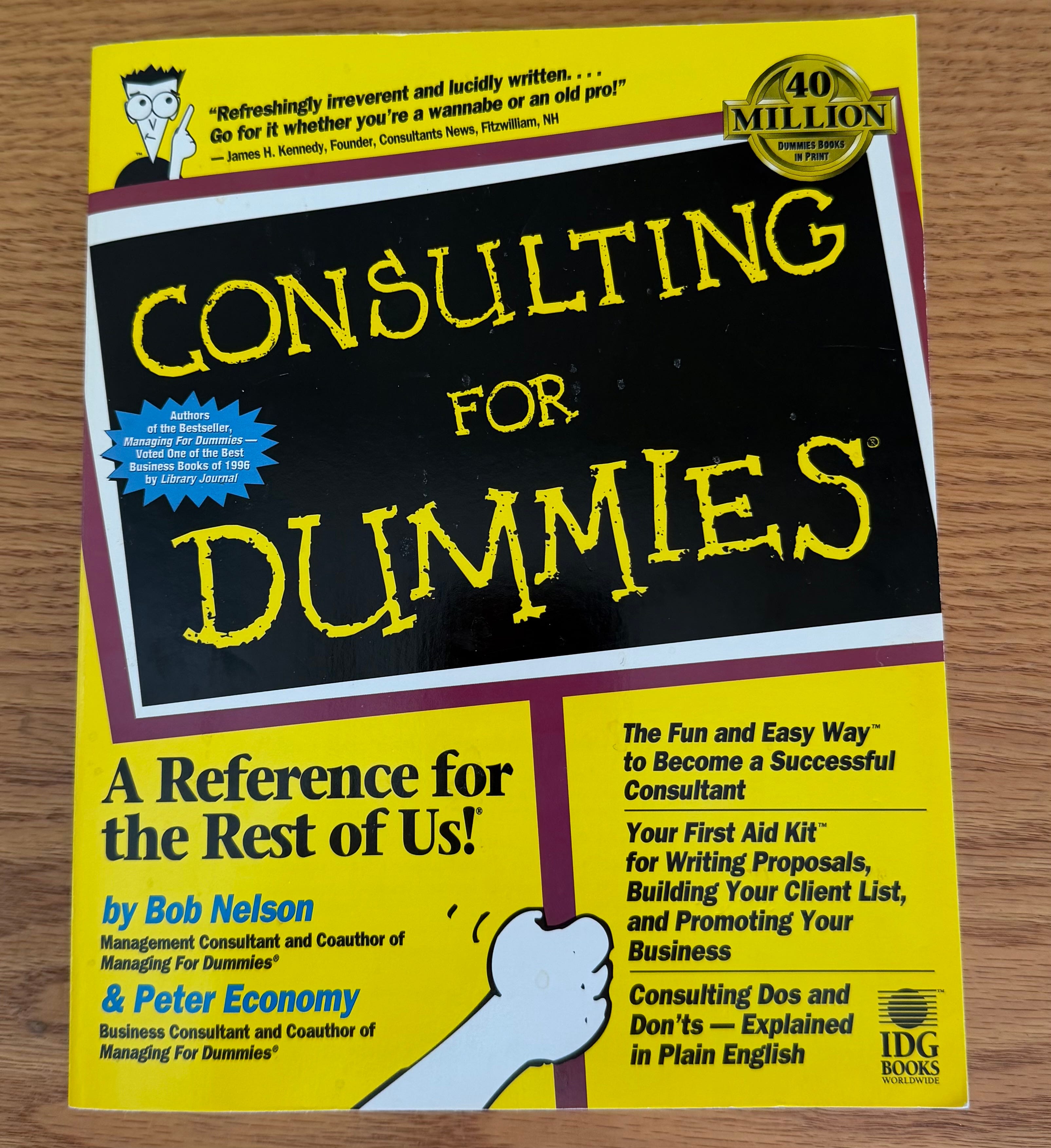
I packaged up four boxes of books over the weekend to take to the charity store. Mostly non-fiction. And as I worked through the shelves, I kept pulling things back into the “keep” pile — until my wife stopped me and asked me to think harder about why.
She was right. It was nostalgia dressed up as necessity.
Her opening move:
“When did you last actually look at these?”
I pushed back. “They’re reference books”, I said.
You see, you don’t read reference books — you consult them. The frequency is irrelevant.
She didn’t blink.
“Okay then. Tell me something in them that you either don’t already understand — or that’s still relevant today.”
Challenge accepted.
I grabbed the first book off the top of the pile. A bright yellow copy of Management Consulting for Dummies. An evergreen topic, I thought. Solid ground.
I flipped to the contents. Hmm, it’s fairly basic... but solid fundamentals, right?
Then I hit it. Buried in the section on setting up your office, an entire eight paragraphs extolling the value of purchasing a cellular telephone, despite its considerable cost.
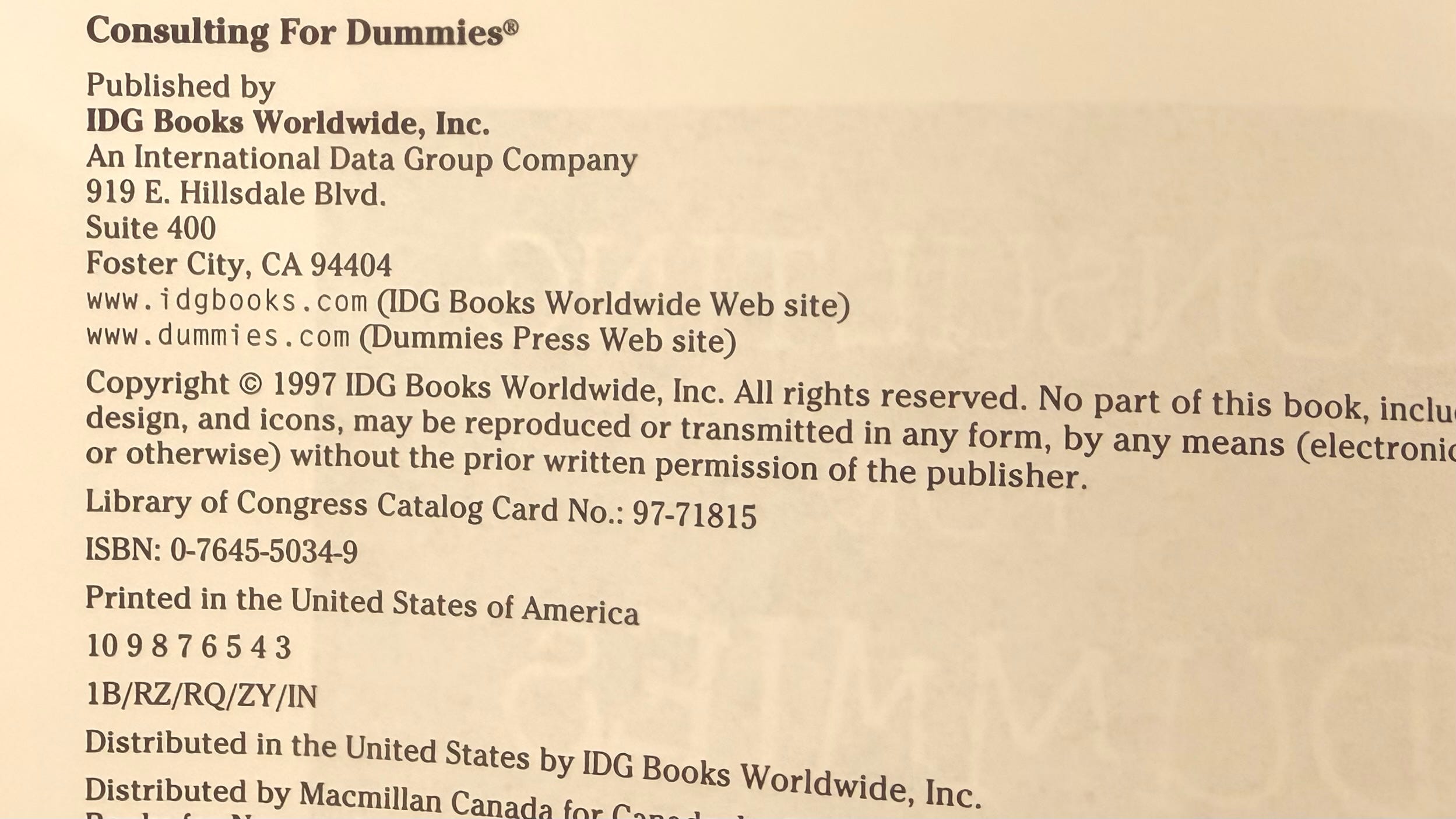
I turned to the front matter.
Published in 1997. Twenty-nine years ago. Oooft…!
My wife, wearing the smile of a woman who has won before she’s even finished speaking, turned on her heel.
Case closed.
The books were loaded for their next life.
Knowledge Management Over the Millennia
Humans have been accumulating knowledge in physical libraries for millennia. Whether grand institutional buildings or three Ikea Billy bookcases wedged into your study, the personal library became a cornerstone of professional identity. There’s a real satisfaction to a well-ordered shelf — aesthetic and intellectual both. For a long time, it was also genuinely functional.
Then came computerisation, and the balance started to shift. Slowly at first — transitory information, administrative records — but as capability grew, so did the migration.
Then the internet arrived, and the shift became seismic. Google and Wikipedia replaced the librarian at the desk. You no longer wandered into a building and asked a human being where you might find something on otters. You just... searched.
And now AI has poured petrol on the bonfire entirely. The way we store, retrieve, and synthesise knowledge has changed beyond recognition in a generation. There’s a legitimate argument — one I find genuinely interesting — that this may be making us intellectually and neurobiologically weaker. But that’s a thread for another day.
The Work Is Still Hard
I’ve written recently about my own journey with personal knowledge management — four decades of trying to use technology to augment my memory and, yes, my physical library. From Lotus Agenda in the late 80s through to what I now call my “Second Brain” — a combination of ChatGPT, NotebookLM, and Google Gemini working together.
This Didn’t Start as a Product. It Started as an “Oh… Sh*t” Moment.

If you are a regular reader of this Substack, you may remember a post I wrote earlier this month.
The tools have changed beyond recognition. The underlying problem hasn’t. The work of curating what you know, what’s still relevant, and what’s just taking up shelf space — that’s always been hard.
But here’s what I’ve learned: your partner watching you dither over a 1997 book about mobile phones is a faster knowledge audit than any app I’ve ever used.
Stop hoarding. Listen to the people who know you best. They’re probably right.
Now, if you’ll excuse me, I need to go have a word with my wife about four decades of accumulated crafting fabric and patterns. 🤣
If you want to read about my journey with Lotus Agenda and the early days of personal knowledge management, you can find the Lotus Eaters article here:
