

The Alignment Files—Part 1: The Three-Way War for the Product Manager’s Soul
Why Health Systems Can’t Agree on What Product Management Actually Is — and What That’s Costing Them

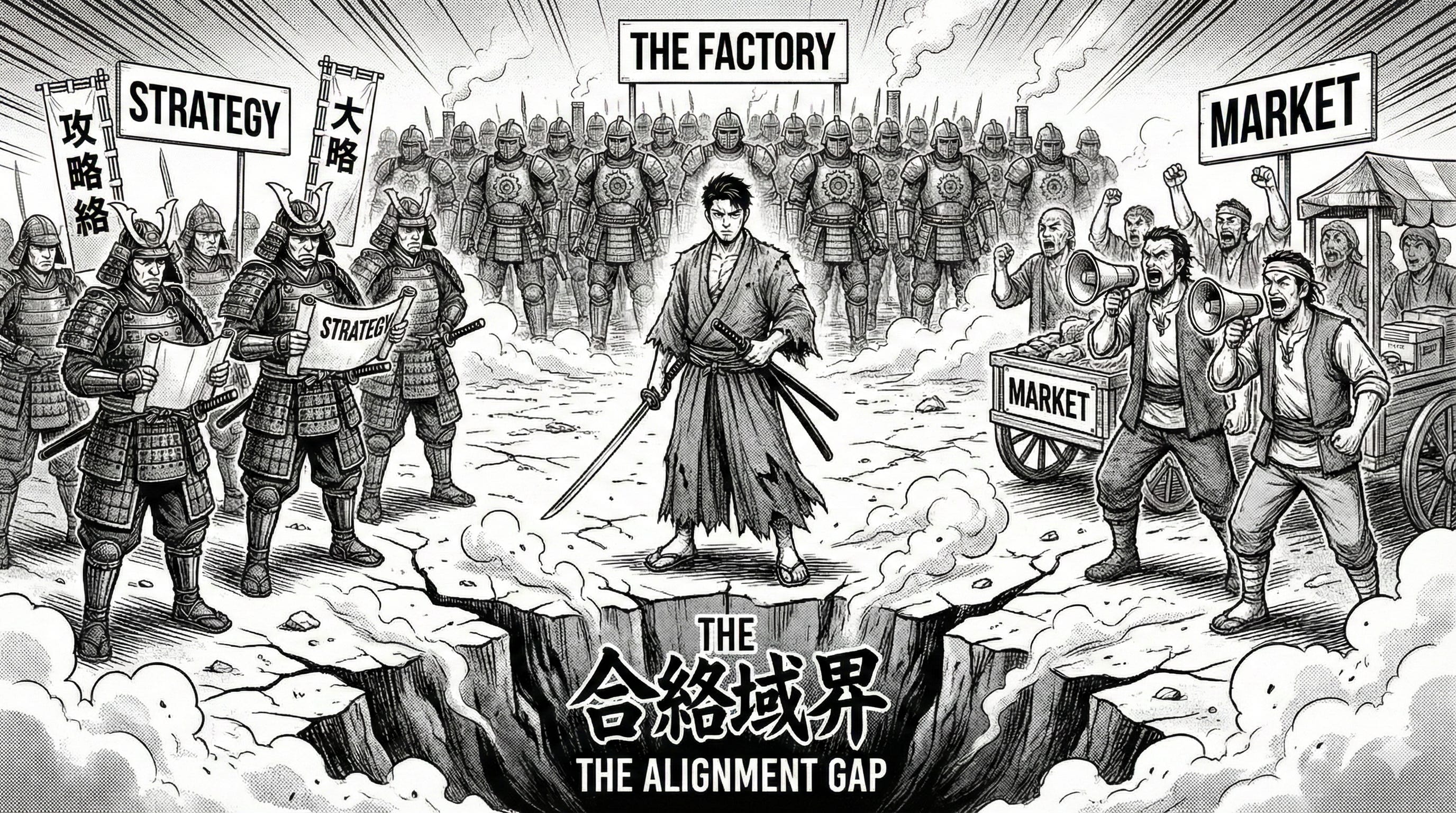
This is Part 1 of The Alignment Files, a series that continues from The Delivery Delusion. Whereas that paper diagnosed the structural failure of delivery-as-success, this series examines the deeper philosophical fractures that make that failure inevitable.
And maybe some prescriptions to gain alignment.
An Existential Question
Health systems are increasingly investing in digital product management. They fund the teams, create the titles, buy the badges, and hire for the role. And yet the function consistently underperforms. Not because the people are weak, but because the organization has never resolved a fundamental question:
What does product management actually do?
Typically, three distinct (and legitimate) philosophies compete for control of the product function. Each one carries its own definition of objectives, KPI’s, success, and operating logic. And its own gravitational pull on resources and authority to make decisions (often times on behalf of the other).
When these philosophies are unreconciled or misaligned, product teams do not fail because of incompetence. They fail from a lack of coherence.
Let’s define the three combatants, map the structural conflict, and define why the failure to manage the tension between them is the root cause of so much of the product dysfunction and dissatisfaction from within health system.
The Disease Beneath the Symptom
In The Delivery Delusion, I argued that many Internal Product Organization routinely deliver technically sound solutions. BUT they fail to produce the outcomes that justify their existence. The factory runs, and yet…outcomes and value never arrive. User customers remain disappointed, jaded.
The Delivery Delusion came out of observing the structural misalignment between three philosophical traditions that now shape organizations' definitions of Digital Product Management.
Each methodology is internally consistent. Each produces genuine insight. And each, when left unchecked and to its own devices, will attempt to dominate the conversation.
The ‘Players’
Strategic Leadership — the product manager as business leader, responsible for vision, P&L, and long-term positioning aligned with organizational imperatives. Exemplified by the Kellogg School of Management’s “CEO of the Product” model.
Market Grounding — the product manager as investigator, responsible for discovering and validating real-world problems before anything is built. Exemplified by the Pragmatic Institute’s NIHITO principle: Nothing Important Happens Inside The Office.
Scaled Technical Execution — the product manager as delivery coordinator, responsible for translating intent into shippable increments through a disciplined process. Exemplified by SAFe and similar adjacent Agile frameworks.
In theory, there is immense value in each of these methodologies' perspectives.
In practice, these traditions do not politely coexist. They compete for the Product Manager’s time and soul, organizational legitimacy, and, most importantly, the prioritization and control of the roadmap and resources.
What Each Gets Right—Where Each Goes Wrong.
Strategic Leadership:
Horizon perspective — 3-5 years; “The North Star”
Principled Stand — insists that product decisions are business decisions. It demands financial literacy. It refuses to let product management retreat into a purely tactical role. Essential questions: “Does this align with our five-year plan? What is the total cost of ownership? What are we not doing to do this?”
Failure mode — altitude sickness. It operates at 30,000 feet, where the oxygen of clinical reality is thin. A product vision can be strategically coherent, financially modeled, beautifully presented — and yet completely disconnected from the nurse's workflow who will be expected to use it. When it dominates unchecked: Visionary Paralysis. Extraordinary clarity about the future BUT…Almost nothing shipped moves toward it.
Market Grounding
Horizon perspective — 6-18 months; “The needs of the user”
Principled Stand — provides a structural defense against the pathologies that plague health system IT: executive intuition masquerading as strategy, vendor promises substituted for user evidence, the “vocal minority” problem where one politically powerful stakeholder dictates direction for an entire population. Its insistence on equal win/loss analysis yields market intelligence that internal product teams rarely possess.
Failure mode — incrementalism. By anchoring so firmly in observed problems, it can become overly responsive to current complaints at the expense of a transformative vision. It excels at identifying friction; it is less equipped to imagine a fundamentally different model of care. When unchecked, exquisite awareness of today’s problems, but a structural inability to lead toward tomorrow’s solutions.
Scaled Technical Execution
Horizon perspective — 3-6 months; “The release schedule”
Principled Stand — addresses a real need: coordination at scale. When a health system has hundreds of developers, dozens of product lines, and regulatory constraints touching everything, disciplined delivery cadence is a rational response to genuine complexity. It makes the invisible visible and the chaotic manageable.
Failure mode — Gravity Well (Black Hole). What I described in The Delivery Delusion: the factory becomes the center of gravity. The roadmap ceases to be a strategic instrument and becomes a feeding schedule. Capacity seeks utilization. The question shifts from “Should we build this?” to “Can we fit this into the next PI?” When it dominates unchecked — and in most large health system IT organizations, it does — the result is a high-performing factory that generates expensive waste.
Why the War Is Structural
It would be convenient to blame individual failure. A strategy leader remote from front-line operations; a Product Manager who is too connected to the voice of the user; a Product Owner who can’t prioritize; a CTO who over-indexes on process. But the conflict is architectural. The limitation is the inability of each ‘tribe’ to be able to horizontally switch
The Chief Strategy Officer thinks in five-year horizons and in terms of competitive positioning. The Chief Digital Officer is supposed to reflect the user's voice. The Chief Technology Officer or Chief Information Officer owns the factory and is measured on throughput and efficiency.
Each is incentivized according to a different definition of product success.
The product manager (if you are lucky!) sits at the intersection — serving all three masters, typically with no power or structural mechanism to resolve the contradictions and conflict. This is not a coordination problem that better meetings can solve. It is a governance and alignment failure. The organization has never defined how the tribes will resolve their differing horizons and priorities, far less which tribe has primacy, under what conditions, and with what accountability.
In the absence of that decision, the loudest voice or the most politically influential wins.
Many times, the factory is loudest — because it has the most visible metrics, the most tangible artifacts, and the most immediate political consequences for failure. The factory wakes up every day with one objective: keep the factory running…survive…grow.
The SAFe methodology compounds this by bifurcating the product role into Product Manager (strategic) and Product Owner (tactical). In theory, this creates focus; in practice, more barriers to understanding.
The overall effect of these different viewpoints and methodological approaches is it creates a Tower of Babel. Everybody is talking. The words sound similar. But “roadmap” means something entirely different to the strategist than it does to the factory. “Priority” means one thing to the Chief Strategy Officer and another to the Scrum Master. “Value” is a financial concept in one room and a velocity metric in the next.
They think they are communicating. They are not.
And the confusion itself generates conflict and offense.
Meanwhile, the people writing code never hear the frustrated cardiologist describe why the referral workflow adds fifteen minutes to every encounter. They receive requirements: sanitized, decomposed, stripped of the context that would let them exercise judgment. And the PM — who should be in the field gathering that context — is pulled into PI Planning ceremonies and stakeholder alignment, translating between tribes who have not yet realized they are speaking different languages.
Why does Healthcare Get Punished Hardest?
There is a difference between Outside Product Organizations (most commercial companies) and Inside Product Organizations (Healthcare and many government, education, and similar organizations).
In a commercial SaaS company, philosophical misalignment eventually surfaces as lost revenue. Customers churn. The users provide the market with very direct, existential feedback through their wallets. The Factory is driven by the singular metric—Revenue.
Health systems lack this corrective. Internal products do not churn. They persist. A clinical tool that fails to gain adoption is not decommissioned; it is maintained. An analytics platform nobody trusts is not sunset; it is “enhanced.”
These are the “Zombie Products” — Live, and yet, not alive.
The cost of misalignment is not visible as lost revenue. It compounds silently as organizational drag — systems that consume resources without producing value.
The three-way war is not an abstraction. It is the structural explanation for why a health system can employ talented product managers who understand product lifecycle, invest in sophisticated frameworks, and still maintain a portfolio of digital products that clinicians do not trust, administrators do not use, and patients never see.
The Path Forward: Alignment, Not Victory
The resolution to the conundrum is not to pick a winner.
Strategy without market grounding produces visionary irrelevance.
Market evidence without strategic framing produces reactive incrementalism.
Both—useless without a factory capable of turning intent into elegant working software.
The failure is not in the traditions of each discipline. It is in the refusal to hold all three simultaneously, and in negotiating and managing the tension as ongoing discipline.
This is the work the remaining articles in this series will take on:
Part 2: The Factory’s Gravity Well examines how the Build Trap operates as performance theater.
Part 3: Intellectual Hitchhiking confronts the question of why AI-accelerated discovery may simply speed the organization over a cliff.
Part 4: The Truth Score introduces a mechanism for surviving the HIPPO — the Highest Paid Person’s Opinion.
Part 5: Breathing in and Out argues the case that this tension is not a problem to be solved or a war to be won, but a series of polarities to be managed.
The factory will always be loud. Strategy will always be seductive. The market will always be grumpy and inconvenient.
The question is, does your organization have the discipline to balance all three, or will it keep letting the loudest voice win by default?
Stuart Miller is Managing Director of Haverin Consulting, a healthcare IT strategy consultancy. Subscribe for Parts 2–5.