

The Alignment Files—Part 4: The Truth Score
How to Survive the HIPPO and Stop Your Roadmap Being a Collection of Expensive 'gut feels'

This is Part 4 of The Alignment Files, a series that continues from The Delivery Delusion. In Part 1, we named the three tribes. In Part 2, we examined the Factory’s gravity well. In Part 3, we exposed Epistemic Freeloading — the dangerous substitution of synthetic validation for real market truth.
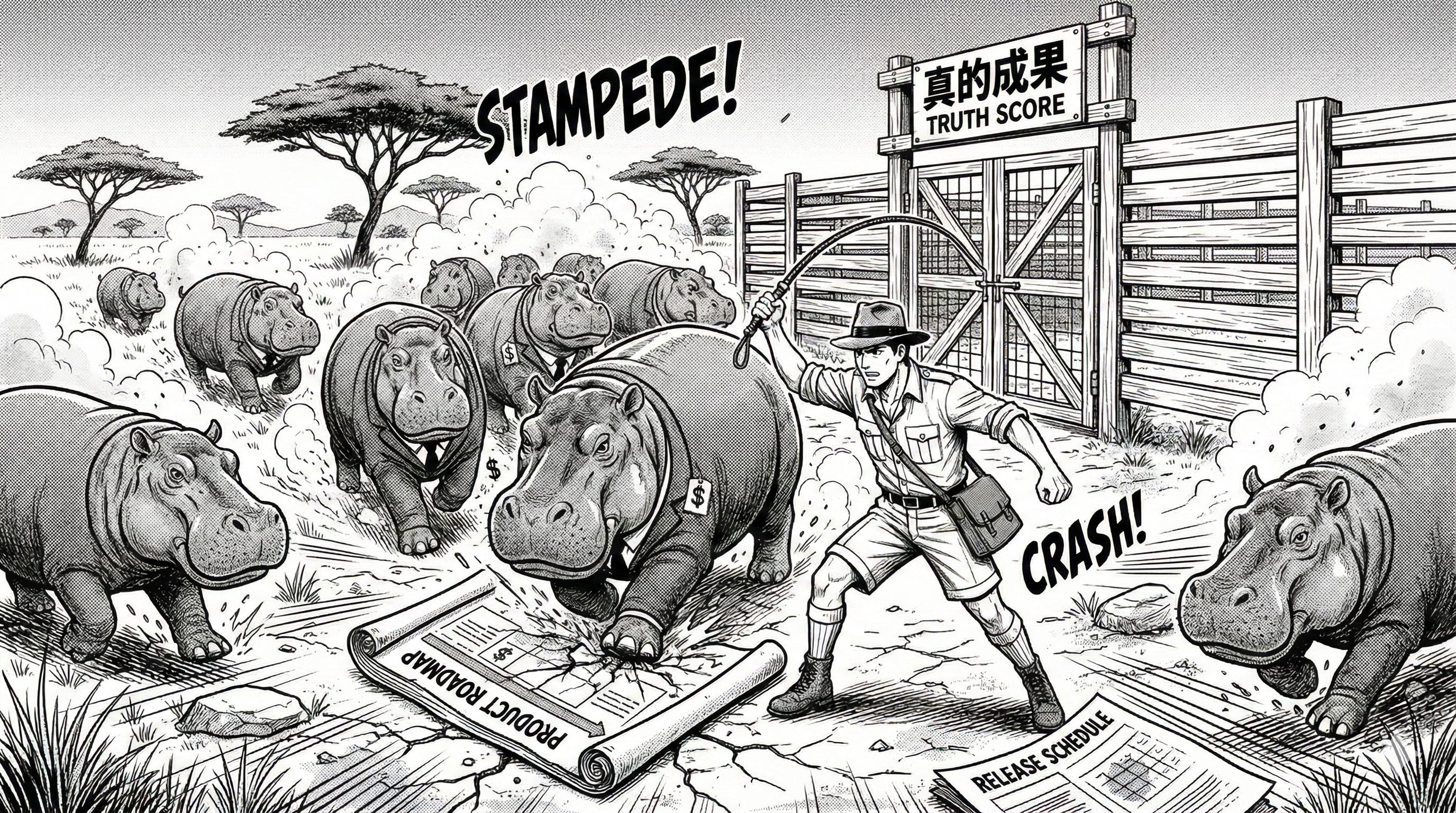
In this part, we introduce a practical mechanism for making evidence quality visible on your roadmap — and for surviving the most politically dangerous animal in any health system: the HIPPO.
The Most Dangerous Animal in the Room
Every organization has them. Often Several!
The HIPPO — the HIghest Paid Person’s Opinion.
The HIPPO is not necessarily wrong. That’s what makes it so dangerous. The CEO, the Chief Medical Officer, the influential Principal Investigator, or the opinionated board member who walks into the room with a “great idea” is often a smart, experienced leader with genuine strategic instinct.
They have pattern recognition. They have authority. They have budget.
What they frequently do not have, is evidence.
And in most health system product organizations, there is no structural mechanism for distinguishing between an initiative backed by validated market evidence and one backed by the enthusiasm of someone with a senior title and a firmly held opinion.
On the roadmap, they look identical.
A feature born from fifty clinician interviews and a feature born from a single executive’s conference takeaway occupy the same row in Jira.
Same priority field. Same projected cost. Same promised benefit. The absence of evidence is invisible — until the product fails.
This is the gap that the Validity Buffer is designed to close.
The Problem of Invisible Evidence Quality
In a typical PI Planning session or quarterly roadmap review, every initiative looks the same. They all have a name, an estimated cost, a projected benefit, and an executive sponsor.
Some have been through months of rigorous Market Grounding work — NIHITO interviews, win/loss analysis, pervasiveness validation. Others arrived because someone important said, “We should really look at this” during a leadership meeting last Tuesday.
On paper? Indistinguishable.
This is not a minor formatting issue. It is a fundamental failure of transparency. To the Strategic Leadership tribe, every item on the roadmap appears equally justified. To the Factory, every item is equally “ready” for the backlog. Nobody is lying. The information simply isn’t there to tell the difference.
And when the HIPPO walks in and drops a new initiative on the table — with energy, conviction, and the implicit weight of their authority (and often additional budget!) — what happens?
The roadmap shuffles. Discovery work is compressed or skipped entirely. The Factory absorbs the new item because the Factory is built to absorb. And the Product Manager, who was six weeks into validating a different problem that three hundred nurses actually need solved, quietly reprioritizes.
We have all watched this happen. Most of us have been complicit in it.
To celebrate the launch of Haverin Consulting, I am providing 50% off an annual paid subscription. Just $25.
Enter the Validity Buffer
The Validity Buffer is a simple concept: a Truth Score for your roadmap.
Instead of evaluating initiatives only by their projected value, we also evaluate the validity of the evidence supporting them. How was this idea researched? What is the quality of the data behind it? Has the problem been validated for pervasiveness, or is it a single anecdote that made it to the right meeting?
Think of it as a confidence coefficient. A discount rate on certainty.
Low Validity (Truth Score: 10–30%):
The idea originated from a single internal meeting, an executive’s conference experience, or an AI persona simulation (Epistemic Freeloading, as we discussed in Part 3)
No NIHITO interviews have been conducted
No win/loss data exists
The “buffer” is thin — the organization is acknowledging, transparently, that it is placing a bet based on assumption
Medium Validity (Truth Score: 40–70%):
Some discovery has been conducted, but has not yet reached saturation
Initial interviews suggest the problem is real, but pervasiveness is not yet confirmed
The initiative has earned conditional entry to the roadmap — worth further investigation, not yet worth full factory commitment
High Validity (Truth Score: 80–95%):
The team has followed NIHITO rigorously
Multiple interviews have been conducted and the team has reached saturation — the point where they stop hearing new complaints and start hearing patterns repeat
Win/loss data or equivalent internal evidence validates the problem
The initiative has earned its place on the roadmap through evidence, not enthusiasm
The Validity Buffer does not stop work. It changes the conversation. It forces the Factory to ask: “Do we have enough truth to build this yet?” And it gives the Product Manager a structural mechanism to say “not yet” — even to the HIPPO.
Speaking the Language of Risk
Here is why this matters strategically, not just methodologically.
The HIPPO does not respond well to “we need more time for research.” That sounds like delay. That sounds like resistance. That sounds like the Market Grounding tribe being precious about process while the initiative driver gets more urgent.
BUT…the HIPPO does understand risk.
Reframe the conversation. You are not saying “I think we need more time.” You are saying: “This initiative currently has a Truth Score of 15%. We haven’t validated it enough to bet the quarterly budget on it. Here’s what it would take to move it to 70%.”
That is the language of risk management. That is the language the Strategic Leadership tribe — those Kellogg-trained, P&L-owning, five-year-horizon tribe — actually speaks.
The Validity Buffer is a translation device. It takes the Market Grounding tribe’s insistence on evidence and expresses it in the Strategic Leadership tribe’s language of investment risk. And it gives both tribes a shared, visible mechanism for evaluating whether the Factory should be activated.
Remember the Tower of Babel from Part 1? The tribes all using the same words but meaning different things? The Truth Score is a shared vocabulary that cuts through the noise. “Priority” can mean ten different things. A Truth Score of 15% means exactly one thing: we don’t know enough yet.
The Sweet Spot: Saturation, Not Perfection
A common objection: “We can’t validate everything to 95%. We’d never build anything.”
Correct. And that is not what the Validity Buffer demands.
The goal is not perfection. The goal is saturation — the point at which additional research stops yielding new information. In qualitative research, this is well understood:
5–8 interviews will typically uncover approximately 85% of usability issues (the Nielsen Norman “5-user guideline”)
9–12 interviews will usually achieve theme saturation — you know what the problem is
15–24 interviews will achieve meaning saturation — you understand why the problem exists and what drives the behavior around it
You do not need a thousand interviews to move the needle. Often, five to eight deep, meaningful conversations with real humans will shift a Truth Score from 15% to 65%. That is the difference between “expensive guess” and “informed bet.”
And that is when the Factory should be given the green light.
Saturation is not a finish line. It is a threshold — the point at which you have earned the right to commit organizational resources to a solution. Below it, you are speculating. Above it, you are investing.
What the HIPPO Looks Like on a Truth-Scored Roadmap
Here’s the practical shift.
The board member walks in with a compelling idea. Instead of the roadmap shuffling silently to accommodate it, the organization has a visible, transparent response:
“Great idea. It enters the roadmap at a Truth Score of 10%. Here is the discovery plan to validate it. If it reaches 60% within six weeks, it earns factory commitment in the next PI. If it doesn’t, it remains in the discovery pipeline — visible, tracked, but not consuming factory capacity.”
The HIPPO’s idea is not rejected. It is respected enough to be validated. And the three hundred nurses waiting for their workflow redesign — the initiative sitting at a Truth Score of 85% — do not get bumped because someone important had a good meeting.
The Validity Buffer does not fight the HIPPO. It domesticates it. The opinion still enters the system. It just has to earn its way to the factory floor.
The Organizational Discipline Nobody Wants to Talk About
Okay (deep breath)…Let’s be real.
The reason most organizations do not implement something like the Validity Buffer is not that they lack the methodology. It is that transparent evidence quality makes powerful people uncomfortable.
A Truth Score of 15% next to a board member’s pet initiative is a politically dangerous artifact. It says, in plain language: this idea has not been validated. That is not a message that every organizational culture is equipped to hear.
And yet, it is exactly the discipline that separates organizations that build products of consequence from organizations that generate expensive Zombie Products.
The Delivery Delusion persists because organizations lack the structural courage to say “not yet” to ideas that haven’t earned their place. The Build Trap persists because the Factory lacks a mechanism to distinguish between validated and speculative work. Epistemic Freeloading persists because there is no visible penalty for synthetic evidence.
The Truth Score addresses all three. Not by adding process.
By adding transparency.
In Part 5: Breathing In and Out, we bring the series home.
The three-way war between the tribes is not a problem to be solved or a battle to be won. It is a set of polarities to be managed — and the organizations that master this discipline will build the products that others only talk about.
Stuart Miller is Managing Director of Haverin Consulting, a healthcare IT strategy consultancy. This is Part 4 of The Alignment Files. Subscribe for Part 5.