

The Alignment Files—Part 5: Breathing In and Out
Why the Three-Way War Is Not a Problem to Solve — It’s a series of Polarities to Manage

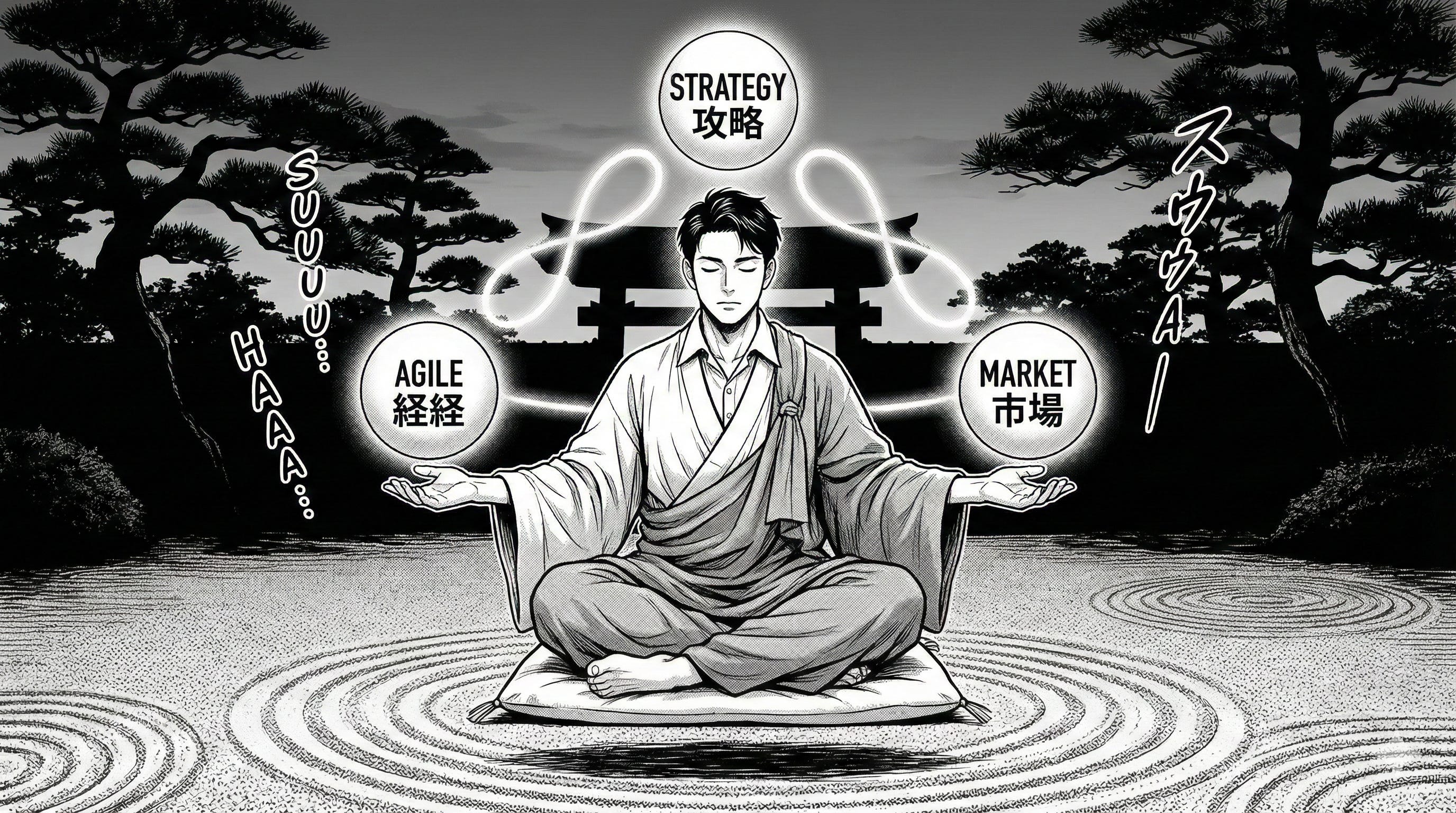
This is Part 5 and the finale of The Alignment Files, a series that continues from The Delivery Delusion.
In Part 1, we named the three tribes. In Part 2, we exposed the Factory’s gravity well. In Part 3 , we confronted Epistemic Freeloading. In Part 4, we introduced the Validity Buffer to domesticate the HIPPO.
Now, we bring it home.
The Trap of “Picking a Winner”
Throughout this series, we have diagnosed what goes wrong when one tribe dominates:
When the Factory wins, you get the Build Trap — performance theater, Zombie Products, and a roadmap that feeds the machine instead of the market (Part 2)
When Market Grounding surrenders to the Factory’s demand for faster, you get Epistemic Freeloading — synthetic evidence masquerading as truth (Part 3)
When the HIPPO overrides both tribes, you get unvalidated initiatives consuming factory capacity while evidence-backed work is perpetually deferred (Part 4)
The instinct, at this point, is to pick the right tribe and give it control. Organizations do this all the time:
“We are a Strategy-led organization!” (The Factory starves. Nothing ships.The Market remains frustrated)
“We are Agile-first!” (Strategy gets lost in the fog. The Factory churns out features nobody in the market asked for.)
“We are Market-driven!” (Everything becomes incremental. The transformative vision dies of a thousand validation cycles, and the factory sits idle)
This is an “Either/Or/Or” trap. And it is the final, deepest failure mode this series needs to address.
The three-way tension between Strategic Leadership, Market Grounding, and Scaled Technical Execution is not a war to be won. It is not a problem to be solved.
It is a set of Polarities to be Managed.
What Is a Polarity?
The concept comes from Barry Johnson’s Polarity Management framework, and it is deceptively simple.
A polarity is a pair of interdependent (but often competing) values that need each other over time for a system to be effective. They are not “problems” with a right answer.
They are ongoing tensions that require “Both/And” thinking.
Breathing is the simplest example of polarity management you can imagine.
Inhaling is good. Exhaling is good.
But if you decide that inhaling is “the answer” and commit to it exclusively…you die.
The value is not in either pole. It is in the rhythm and balance between them. In practice, healthcare (and indeed life) is chock full of polarities.
One well-known healthcare polarity is the tension between the Mission of why a hospital or health system exists, and the Money of running a healthcare system.
Product management in a health system works the same way. Strategy is essential. Market evidence is essential. Execution is essential.
The value is not in choosing which one matters most. It is in the organizational rhythm that holds all three in dynamic balance.
Over-focus on any one pole, and you experience the downsides of all three.
Why Pairs? Why Not a Three-Way Map?
A natural instinct at this point is to attempt to map all three tribes onto a single model and manage the tension across all axes at once. While that sounds elegant, it is also unworkable.
Polarities are managed in pairs. Always. This is not a simplification; it is the fundamental architecture of the Polarity Management methodology.
Each polarity is a specific energy system: two interdependent poles in constant, predictable tension. Think of the infinity loop in the cartoon diagram. Energy flows from one pole to the other and back again, endlessly.
Over-focus on one side, and the system naturally generates pressure to swing toward the other. The skill is not in stopping the swing. It is in managing the rhythm so the system captures the upsides of both poles while minimizing the downsides of each.
Negotiation is the weapon of choice here.
You cannot do this across three axes simultaneously. The tensions are too different, the failure modes too distinct, the early warning signals too specific.
Instead, you stack them. Each pairing at the tribal borders is its own polarity, with its own infinity loop, its own upsides and downsides, its own rhythm.
If you can successfully manage each pair discretely, the aggregate effect is organizational alignment across all three tribes.
No single polarity achieves the greater purpose alone. The rhythm across all three sets of polarities is what gets you there.
The Three Core Polarity Pairs
When we map the trilateral conflict from Part 1 onto Johnson’s Polarity Management framework, three specific polarities emerge.
Each operates at a border between two of the tribes. If one dominates the other, then strains and fault lines arise.
Each of these pairs has a healthy state and a failure state. And each has early warning signals that tell you when the organization has tipped too far.
1. Strategic Vision vs. Execution Throughput
(The border between Kellogg and SAFe — the 3–5 year horizon meets the 3–6 month cycle)
The tension: Long-term business architecture and capital allocation vs. immediate delivery commitments and burn-down charts.
Over-focus on Vision: Visionary Paralysis. The organization strategizes beautifully and endlessly. Decks multiply. Visionary roadmaps are pristine. Nothing ships. The Factory starves while leadership debates and shifts the priorities for the five-year horizon for the third consecutive quarter.
Over-focus on Throughput: Soul-Crushing Agile. Velocity becomes a hollow metric. Sprints are full. PI objectives are met. But nobody can explain how any of it connects to where the organization needs to be in three years. The North Star is in the executive presentation and stays there. The agile work is somewhere else entirely.
The healthy rhythm: Every sprint is a measurable step toward the strategic horizon. The Factory does not just execute; it executes in a direction. Strategy does not just envision; it is expressed in deliverable increments that the Factory can plan, focus on, and act on.
Early warning sign: When was the last time anyone in a sprint review referenced the three-year strategic plan? If the answer is “never,” you have tipped into throughput.
2. Market Agility vs. Process Predictability
(The border between Pragmatic and SAFe — the 6–18 month horizon meets the PI cadence)
The tension: Responding to real-time market truth (NIHITO) vs. the stability of a committed Program Increment plan.
Over-focus on Agility: Constant pivoting. The roadmap keeps shifting whenever a new interview round surfaces a new complaint. No feature achieves depth. The Factory never finishes anything because the target keeps moving. Discovery becomes an excuse for indecision.
Over-focus on Predictability: The Build Trap, in its purest form. PI plans are locked. Commitments are sacred. The market moved six weeks ago, and the Factory is still building yesterday’s features because they were “committed” in the PI Planning ceremony. Evidence arrives and has nowhere to go.
The healthy rhythm: PI Planning includes dedicated, protected capacity for discovery sprints. New market evidence has a defined entry point into the cadence — not disruptive, not ignored, but structurally accommodated. The Factory can pivot within the increment, not just between them.
Early warning: Is 100% of engineering capacity locked in PI objectives with zero room for investigation? If yes, the organization has formally decided to stop learning. Most have. Few have admitted it.
3. Strategic Vision vs. Market Evidence
(The border between Kellogg and Pragmatic — the 3–5 year transformative horizon meets the 6–18 month evidence base)
The tension: Leading the market toward a future the user hasn’t articulated yet vs. anchoring every investment in validated, pervasive problems that real people have described in real interviews.
This is the most intellectually interesting and challenging polarity — and the one organizations are typically worst at managing.
The strategist says,
“If we only build what users ask for, we will never Transform anything. Nobody ever asked for the iPhone.”
The market investigator says:
“If we build without evidence of the market-problem fit, we are guessing with conviction. And conviction is not a business case.”
They are both correct. That is what makes it a polarity.
Over-focus on Vision without Evidence: Elegant Irrelevance — the phrase we used in Part 1. The strategic deck is beautiful. The five-year vision is compelling. The CEO is energized. And none of it maps to a problem that real clinicians experience as urgent or pervasive.
This is also where the HIPPO lives. The HIPPO is almost always a Strategy tribe actor — imposing vision without evidence, powered by pattern recognition and authority rather than ground truth. The Validity Buffer from Part 4 sits directly on this border.
Over-focus on Evidence without Vision: Incrementalism. The product team has exquisite awareness of every friction point in the current workflow. Every complaint is catalogued, validated, and saturation-tested.
And the roadmap becomes a sophisticated maintenance operation — solving today’s problems with precision, but with no line of sight to a fundamentally different model of care. You become the best-informed team in the building, and you never transform anything.
The healthy rhythm: Strategy proposes the direction. Market validates whether the direction maps to real, pervasive problems. Vision enters the system — but it earns its evidence before consuming factory resources.
The Validity Buffer is the mechanism that makes this rhythm operational: strategic initiatives enter at a low Truth Score, and discovery work either validates them upward or exposes them as elegant guesses. Meanwhile, market evidence is not just catalogued — it is interpreted through a strategic lens that asks: “Does this friction point tell us something about where care delivery is heading, or is it just a complaint about today?”
Early warning: Are strategic initiatives entering the roadmap without passing through any market validation gate? You have tipped into vision. Conversely, has the roadmap become entirely reactive, driven by current complaints with no connection to a transformative outcome? You have tipped into incrementalism.
The sharpest diagnostic question: Can anyone on the product team articulate how the current quarter’s validated market problems connect to the three-year strategic vision? If the answer is a blank stare, the two tribes are not talking to each other.
The Role Nobody Has Named
If these polarities are real (and if you have been nodding along through this series, you know they are), then someone in the organization needs to own the rhythm.
Not just Strategic Leadership. Not just Market Grounding. Not just Scaled Technical Execution.
The rhythm between the three.
That is not typically the Product Manager’s job as typically defined. The Product Manager, as we discussed in Part 1, is caught in the crossfire — serving three masters with no structural mechanism to reconcile them, and no authority to enforce balance.
It is not the Chief Technology Officer’s job. The CTO owns the Factory and its performance.
It is not the Chief Strategy Officer’s job. The CSO owns the North Star.
And it’s not the Chief Digital Officer’s job. The CDO owns the Market and its users' and buyers' needs.
The role that is missing is the Polarity Navigator — the person (or function) whose explicit purpose is to detect when the organization has over-rotated toward one pole and to initiate the correction before the failure mode sets in.
In practice, this is instinctive for the very best executive leaders. They sit at the intersection of vertical strategy and horizontal throughput, quietly resolving the contradictions that arise at tribal boundaries. Negotiating the fragile peace of organizational politics and culture.
But “instinctively” and “quietly” are not organizational disciplines. They are individual heroics. And individual heroics do not scale.
Organizations that embrace polarity management will formalize it. Not as another process layer — God knows we don’t need more process — but as an explicit accountability with early warning metrics, intervention authority, and a seat at the table where roadmap decisions are made.
Bringing It Home
This series began with a simple observation: the Delivery Delusion persists not because organizations lack talent or technology, but because they have never resolved a fundamental philosophical conflict about what product management is and what it is there to do.
Five articles later, here is where we landed:
The three-way war between Strategic Leadership, Market Grounding, and Scaled Technical Execution is real, structural, and present in every large health system IT organization. It is not going away quietly. (Part 1)
The Factory’s gravity well is the most common failure mode — not because the Factory is malicious, but because it is loud, visible, and self-reinforcing. (Part 2)
Epistemic Freeloading is the newest and most seductive threat — the promise that AI can replace the hard, human work of market discovery. It cannot. (Part 3)
The Validity Buffer is a practical mechanism for making evidence quality transparent and protecting the roadmap from the HIPPO effect. (Part 4)
And Polarity Management is the discipline that holds it all together — the organizational change regulator that prevents any single tribe from dominating at the expense of the others. (This article)
The Factory will always be busy and loud. Strategy will always be urgent and imperative. The Market will always be grumpy and inconvenient.
Nobody’s baby is ugly. But the babies have to learn to share the toys in the nursery.
The organizations that thrive will not be the ones that pick the right tribe. They will be the ones who master the rhythm between all three — breathing in and breathing out, repeatedly, deliberately, with the discipline to notice when they have been holding their breath too long.
Choose to breathe!
Thank you for joining me for The Alignment Files. If you are ready to move beyond Feature Factories, Zombie Products, and Synthetic Stagnation, I would love to help you build your own alignment architecture.
If you would like to explore what we can do together, please use my Calendly link below to book a short discovery call.
You can find my availability by clicking this link to book some time.
Stuart Miller is Managing Director of Haverin Consulting, a healthcare IT strategy consultancy. Subscribe to Haverin About… for more deep dives into the intersection of AI, Product Management, and the human experience of healthcare.